Showing posts with label foot pain. Show all posts

Thursday, March 19, 2015

Strengthening Your "Foot Core" May Reduce Injuries

Running injuries are often caused by failure of the stabilizing muscles of your feet that make up your “foot core”. We all talk about how important “core” stability is in preventing injuries, but most of the focus is on our hips, pelvis and back. What about the tiny little “foot core”? There was a really interesting article in this month’s British Journal of Sports Medicine, which make the case that we shouldn't ignore our “foot core”.  In fact, the  authors challenge us to move beyond lifetime orthotic control; and after treating an injury with stabilization and rest with an orthotic, slowly wean the runner away from their orthotics by gradually stabilizing the “foot core”. Interesting paradigm shift! I'm not ready to get rid of my orthotics, but perhaps this is really not so new; but just another way to meet the demands of runners who want to go back to natural running style without the use of corrective orthotics or stabilizing shoes. Hmmm. Sounds like the exercises we presented years ago to stabilize your feet in order to introduce minimalism? I definitely see where this could be helpful in treating all of our runners that don’t have overwhelming biomechanical issues. It certainly can’t hurt!!

So what makes up the “foot core”?

Your feet have extrinsic and intrinsic muscles.  Extrinsic muscles originate far away from the joints that they move.  These are the toe muscles that start on the shin bones and turn into tendons that attach on the ends of the toes.  They can curl and extend the toes, but they do it by crossing over the many small bones and joints of the foot.
Intrinsic muscles originate and attach within the same body part.  In the foot, they originate on the heel bone or long bones of the arch of the foot and attach on the toes.  The intrinsic muscles are like the “core” muscles of the foot.  Because they are deep and don’t cross over too many joints, they can work well in stabilizing and protecting the arch and structures within the foot.  There are actually 11 tiny little intrinsic muscles in your feet, but they have a big job to do. When the foot intrinsic muscles are weak, the foot structures are more prone to increased stress and injury.  Strengthening the intrinsic muscles of the foot is good for people with foot injuries (especially plantar fasciitis) and of course those looking to prevent injury.

So how do we strengthen the “foot core”?

Here are some examples of foot intrinsic strengthening exercises.  They can be done either in sitting or standing, one foot at a time, or both together.  At first, the movement may seem impossible, but if you practice for a few minutes a day, you will start to see the toes working with better control.
1)    “Toe Swapping” – Start with your foot flat on the floor with equal pressure on your heel, the base of the big toe, and the base of the little toe.  Raise up the big toe while keeping the other 4 toes flat and pressed into the floor.  After holding a few seconds, try the opposite.  Flatten the big toe down into the floor and try to lift up the 4 small toes.  Try not to let your whole leg roll back and forth as you swap back and forth between the big toe and the 4 small toes.  You can start by using your hands to hold the toes in place to help your body learn how to isolate the toe movement.
2)    “Playing the Piano” – Start with your foot and all the toes flat with equal weight on the inside and outside of the foot.  Raise the big toe up by itself as in the previous exercise.  Keeping the big toe up, raise up the second toe to join it.  Then add the third toe, the fourth, and the pinky.  Try to make each toe come up separately.  Once all the toes are up off the floor, start putting them back down one at a time starting with the little toe.  Keep rippling them up, and then down, like someone playing scales on a piano.
3)    “Doming” – Start again with the foot flat on the floor.  Try and press the underneath side of the small knuckles of the toes down into the floor.  This should make the main knuckles closest to the foot raise up like a dome.  The toes need to stay long and straight.  When the toes curl under, it’s the extrinsic muscles working, not the intrinsic.
These movements will be a little frustrating at first, but they will strengthen the “core” muscles of the foot.  They also make good party tricks. 

There is a great video on strengthening your feet to prepare for minimalist running (by yours truly) that gives you 6 more simple exercises to strengthen your feet! Check it out! And of course, if you have any foot pain that is not resolving, consult your favorite podiatrist!


On a side note: The quest to run 2015 miles in 2015 is still moving forward! We hit 400 miles this weekend at the Dallas Athlete’s St. Patrick’s Day Triathlon! Fun Times…..Now 1615 miles to go…..See you at the Dallas Rock & Roll Half Marathon this weekend! 

Tuesday, October 29, 2013

Do You Have Subluxing Cuboid Syndrome? A Pain in the Outside of Your Foot!


Do you have pain and weakness along the outside of your foot? Perhaps you have a history of a traumatic sprain from landing on another person’s foot or falling off a curb. Maybe there is no history of acute trauma but gradual onset of pain over a period of time that doesn’t respond to physical therapy, injections or anti-inflammatories? Sounds like cuboid subluxation syndrome!

What Causes Cuboid Subluxation Syndrome?

Injury to the joints and ligaments around the cuboid bone during an inversion ankle sprain results in cuboid subluxation syndrome. Cuboid syndrome is a common cause of lateral foot pain in the athletic population and is often misdiagnosed or mistreated. It is a minor disruption or subluxation of the structural integrity of the calcaneocuboid portion of the midtarsal joint.

An athlete with a cuboid subluxation will complain of lateral foot pain and weakness in push-off. The pain often radiates to the plantar aspect of the medial foot, the anterior ankle joint or distally along the fourth ray. It is common in ballet dancers and runners.

During a physical exam, there is pain upon palpation on the plantar surface of the cuboid. Sometimes the subluxation can be reproduced, but not often since it is usually subtle. It is important to be aware that diagnosing cuboid syndrome via radiographs, computerized axial tomography (CT) scans or magnetic resonance imaging (MRI) is difficult because of the normal variations that exist between the cuboid and its surrounding structures, and the minimal amount of subluxation that is usually present.
What else could it be? 

  • ·      Sinus tarsi syndrome

  • ·      Lateral process fracture of the talus

  • ·      Acute tendinitis of the peroneus longus tendon

  • ·      Fracture of the anterior process of the calcaneus
  • ·      Malalignment of the lateral ankle and subtalar joints

  • ·      Fractures (including stress fractures)

  • ·      Gout
Inflammatory and noninflammatory arthritis

  • ·      Tarsal coalitions (in adolescents)

Once one has diagnosed cuboid syndrome, reducing the subluxed cuboid is the first step in the treatment process. Clinicians may employ a manipulative technique, which is often defined as a low-amplitude, high-velocity mobilization at the end of joint range, to restore proper joint congruency.
Afterward, patients should use a cuboid pad in conjunction with a taping technique to maintain the cuboid reduction and give the arch added support.
 Keep in mind that the cuboid pad may at times spontaneously adjust a mildly subluxed cuboid by its upward thrust.
Long-term treatment is a semirigid orthotic with a cuboid pad placed on the device. Physical therapy techniques are often used to return normal foot function. Patients may gradually return to sports activity when the pain subsides.
Keep in mind that cuboid subluxation following a second-degree or third-degree lateral foot sprain requires special care in order to prevent the development of a chronic condition. If one suspects a cuboid subluxation after a lateral foot sprain, reduction is not attempted until the swelling and bruising have significantly diminished and the possibility of a fracture has been ruled out.
Bottom line: after an inversion sprain, if you still have lateral foot pain once the swelling has gone down, you may have subluxing cuboid syndrome. An evaluation and treatment of a subluxed cuboid is essential in order to restore normal joint range of motion, alleviate pain and improve foot function.

Friday, May 31, 2013

When Do I Need New Orthotics?

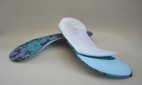
Contrary to popular opinion, custom foot orthotics do not last forever! It is amazing to me how many runners come in with an injury and take orthotics out of their shoes that were made when I was in high school! If your orthotics are more than 5 years old, they probably need to be replaced. Feet change and the devices start to wear out.

If you can't remember how old your orthotics are, here are some tips on how to determine if it is time to replace them:

  • Your feet hurt!!! That pain you had reduced or cured with the device has made a comeback – I can’t think of a better reason to get your feet and devices checked
  •  Yourorthotics are held together with duct tape, gorilla glue and cardboard – those home modifications just don’t do the trick
  • If your orthotics wobble, you may fall down – motion in devices that wasn’t there before can lead to foot pain and instability
  • The top cover looks is thinner than you remember or has comletely fallen off – with time all materials will flatten and wear, if your top cover is paper thin, looks like a piece of foam Swiss cheese, or has been missing for months, get it replaced.
  • Cracks do not give character – cracks in the shell of device can occur with prolonged use, glue is not the answer and neither is duct tape.
  •  Added modifications are lost, loose or not providing the control or pressure relief they used too – just like top covers, modifications can flatten with time, and they can loosen and get lost.


These are just a few subtle reminders of when you need to have your orthotics replaced.   Obviously other problems occur.  While most devices last for several years, most insurance companies will replace a device yearly if problems with device are noted, so don’t hesitate and stop by for an evaluation. Just like eye glasses, your orthotics should be evaluated at least once a year by your favorite podiatrist!

Wouldn't a new pair of orthotics feel wonderful?

Wednesday, March 20, 2013

Custom Orthotics vs Off the Shelf Arch Supports


In this video, Grapevine podiatrist Dr. Marybeth Crane of Foot and Ankle Associates of North Texas explains why custom orthotics are frequently better than prefabricated orthotics.


Custom foot orthotics are made to fix the biomechanics of your foot; however, they’re not for everyone. If you don’t have an underlying problem, but just need a bit of arch support, an off-the-shelf insert may work well for you. However, if you have a repetitive stress injury or foot deformity, then the only thing that you should be using is a custom foot orthotic.

When choosing a practitioner, you need to make sure he or she is experienced in making the orthotics that you need. A three-dimensional scan or cast of your foot should also be made in order to make your orthotic—which is considered the gold standard.

The second thing to consider is which shoes your orthotics need to fit into. Your podiatrist should consider this when fitting you for your custom orthotic.

The last thing to consider is how long your orthotic is going to last. Based on your size and use of the orthotics, your doctor should be able to give you an expected timeframe.

If you’re experiencing foot pain, the first thing to do is visit a Grapevine foot doctor. We will examine the causes of your pain and develop a treatment plan just for you, in order to get you back on the path to a pain-free lifestyle. http://www.faant.com 

Tuesday, January 22, 2013

Breaking News: Bunions Hurt! (video)

The Wall Street Journal reported today that bunions are painful and occur in all age categories. In fact, over 23% of the population suffers from bunions. Dr Crane discusses this prevalent foot problem in this short video. For a more comprehensive look at bunions, click here.


Sunday, July 29, 2012

Paula Radcliffe Sidelined from London Olympic Marathon Due to Arthritic Foot Injury


Paula Radcliffe, the world record holder in the women’s marathon, withdrew from the Olympics today. Radcliffe, 38, has competed in four Olympics, but has never won a medal.  She experienced a flare of degenerative arthritis in her foot about 3 weeks ago and just can’t push off normally. She was quoted to say that her joint was “degenerative and badly damaged’, but does not expect that this will end her career.

Radcliffe failed to finish the 2004 Athens Olympics marathon and was 23rd in Beijing four years later after deciding to race while still recovering from a stress fracture in her thigh. She finished fourth in the 10,000 meters in Sydney in 2000 and was fifth in the 5,000 in Atlanta.

She is a three-time winner of the London Marathon, and had hoped for one more big victory in the capital.

Sadly, this is probably the end of her Olympic hopes. At 38, it is doubtful she will return to top form in 2016 at the age of 42. Doubtful, but not impossible!

Degenerative arthritis of your foot can be treated with anti-inflammatories, injections, functional foot orthotics, physical therapy, and surgery. Surgery can included cleaning up the joint, fusing the joint or replacing the joint with an implant or spacer. If you suffer from arthritis in your foot, there are many treatments available. Contact us or visit your local podiatrist to discuss your symptoms and options for treatment.

All is not lost for Paula Radcliffe. She will return to running, but will probably never claim that elusive Olympic medal.