Showing posts with label running injuries. Show all posts

Tuesday, May 13, 2014

Vibram Settles Lawsuit for False Advertising of the Benefits of Barefoot Running

Vibram, the company behind FiveFingers shoes, just settled a $3.75 million class action lawsuit over false claims that its running shoe yields health benefits, Runner's World reports. The thin-soled, flexible shoes, which cost about $100 a pair, are said to mimic the experience of running in bare feet, and thus "improve foot health" -- an unsupported claim the company falsely advertised. This was also reported in the Huffington Post on 5/10/14. 

The company extensively advertised that their shoes would strengthen muscles in the feet and lower legs, improve range of motion in the ankles, feet and toes; stimulate neural function important to balance and agility, eliminate heel lift to align the spine and improve posture, and allow the foot and body to move naturally.

Does this mean that all of these claims are false? Does it mean that we should get rid of all of our "zero drop" minimalist shoes? No, but it means that not everyone benefits from the use of these types of shoes and that caution should be taken when transitioning from traditional running style to more of a "barefoot feel".

Personally, I have seen some benefits from sprinkling in barefoot running and using a more minimalist shoe for tempo runs and track workouts. I also have many patients who praise the change to a more minimalist shoe; but I also have lots and lots of casualties from minimalist running. At one point in my Grapevine, Texas office, we had a tally going on a white board of the number of stress fractures linked to Vibram-type shoes.

Bottom line: Minimalist running should be approached with caution and pre-hab strengthening of your feet before shedding your traditional running shoe is a must; but just like very other fad that has passed throughout he running community, its not all bad!


Tuesday, March 4, 2014

Long Second Toe Causing Pain on the Run?

Do you have a freakishly long second toe? Does the ball of your foot or your second toe hurt after running? Is the toenail on your second toe deformed or black? You may have what has been coined as “Morton’s toe”.  Really this is a condition that is usually characterized by a cosmetically long second toe; but really it’s a short, hypermobile 1st ray (that’s your big toe and the metatarsal behind it) and a long second metatarsal (often the same length as the 1st metatarsal).


This foot structure is known to cause lower extremity pain due to hypermobility. Examples of problems associated with this foot type are:

            Metatarsalgia (ball of foot pain)
            Morton’s neuroma
            Capsulitis of the 2nd MPJ
            Hallux Valgus or Limitis
            Metatarsal stress fractures
            Plantar fasciitis
            Calluses
            Hammertoes
            Posterior tibial tendonitis
            Shin splints
            IT Band Syndrome
            Chondromalacia
            Calf strains
            Lower Back Pain, Piriformis syndrome and even neck pain!

Wow! Lots of problems due to an inherited foot type!  Morton’s toe can really affect your posture and change the way you run and walk.  The most common thing that we see is an excessive adductory twist on toe off (also called late-stage pronation). This is when you barely pronate in your rearfoot but wear away the forefoot of your running shoe with a twisting motion when you push off.

There are no running shoes that are fabricated to stop late stage pronation or an adductory twist, but a simple functional orthotic can really change the function of the inherited unstable foot and allow you to run, jump and play with all the other kids without pain.

So, if you do have a freakishly long 2nd toe and have had a myriad of postural symptoms, give us a call and let’s see what we can do to straighten that wobbly tire with a functional orthotic prior to contemplating surgical correction!

Tuesday, November 5, 2013

To Stretch or Not To Stretch Before Running


Why do most men forego stretching and then wonder why their Achilles tendons, plantar fascia and hamstrings bother them? They also see to forget to warm up in the winter! Alright, to be fair, its not just men……many runners seem to be too busy to warm up or stretch but seem to have time to visit my Grapevine, TX office when they can’t run from tendon pain!
In all fairness, it seem that the jury is still out when it comes to stretching in the running community. To stretch or not to stretch? That is the question…..
I have been running for more than 30 years with multiple coaches on numerous competitive levels, all of them told us to stretch daily to get faster and avoid injury. Yet many incredibly competitive runners never stretch and never seem to get injured.
Is there any proof that this common recommendation is actually valid? What do the studies say about stretching? Does it really prevent injury? Will it make me faster? Again, the experts really don't agree on much! In most arguments between stretchers and non-stretchers, it inevitably comes down to "stretching helps prevent injuries" and "stretching is a leading cause of injuries in runners". 


The motion of running, repeated over many years, strengthens and shortens several posterior muscles. The most affected are the calves, the hamstrings and the lower back muscles. These muscles play a primary role in lifting the feet and moving the runner forward. Exercise physiologists blame shortened muscles for a reduced range of motion, decreased athletic performance and increased risk of injury. To add insult to injury, the aging process contributes to further loss of joint and muscle flexibility. 


The majority of runners and coaches believe stretching improves performance and reduces the risk of injury. In the meantime, experts disagree on the benefits and dangers of stretching. While many experts credit stretching with numerous benefits, improper stretching remains the second leading cause of running injuries!
So, if we believe in stretching; what is the most effective method? 


First and Foremost; the warm up and cool down should never be optional in your running routine! Cold muscles are at the highest risk for injury; by warming up and increasing the temperature of your muscles they will be more flexible and have an increased speed of motion. Warming up can loosen your muscles and soft tissue as much as 20 percent. The cool down allows blood to continue flowing through your muscles, working its way more slowly from a high level of exertion to its normal resting condition. Build stretching into your regular schedule, both before and after your daily run; after warm up and as part of your cool down. Take the time, it's worth it! 


The Do's and Don'ts of stretching: 


Do 


1.    Warm up prior to stretching. Walk or slowly jog at least 10-15 minutes prior to stretching. 

2.    Slowly add stretching to your workout slowly. Gently stretch a little more each day. Your muscles can actually stretch almost 1.5 times their length, but if you try to achieve this all at once you will hurt yourself! 

3.    Relax. Tension makes it almost impossible to stretch effectively 
Breathe. That may sound easy but try to breathe from you diaphragm or stomach 

4.    Make it a routine, try to stretch every day, even if you don't run. Follow the same order of stretches every time for consistency 

5.    Listen to your body. Some days, less is more! 


Don't 

1.    Don't bounce!! Bouncing risks pulling or tearing the muscle you're trying to stretch and relax. Muscles must be stretched gradually. 

2.    Don't hold your breathe 

3.    Don't stretch if it hurts 

4.    Don't forcibly stretch an injured muscle, gentle and less is more 

5.    Don't hurry through your routine 

6.    Don't listen to your friend’s opinions about the best technique for stretching Try them all and decide what works for you
Bottom line: Most experts agree that stretching reduces muscle soreness after running and results in better athletic performance. Gentle stretching after a race or intense workout can also promote healing and lactic acid removal from the muscles. Stretching is most effective when performed several times each week; a minimum of one stretching session per week is sufficient to maintain flexibility.
Most coaches and runners believe in stretching before and after every workout. The experts never agree on much, but the majority seems to feel that stretching is beneficial to runners if done properly. So follow the precautions outlines and always warm up prior to stretching. Your body will thank you and who knows, you may even get a little faster! 


Run Happy! And warm up and stretch before!

Friday, May 31, 2013

When Do I Need New Orthotics?

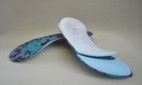
Contrary to popular opinion, custom foot orthotics do not last forever! It is amazing to me how many runners come in with an injury and take orthotics out of their shoes that were made when I was in high school! If your orthotics are more than 5 years old, they probably need to be replaced. Feet change and the devices start to wear out.

If you can't remember how old your orthotics are, here are some tips on how to determine if it is time to replace them:

  • Your feet hurt!!! That pain you had reduced or cured with the device has made a comeback – I can’t think of a better reason to get your feet and devices checked
  •  Yourorthotics are held together with duct tape, gorilla glue and cardboard – those home modifications just don’t do the trick
  • If your orthotics wobble, you may fall down – motion in devices that wasn’t there before can lead to foot pain and instability
  • The top cover looks is thinner than you remember or has comletely fallen off – with time all materials will flatten and wear, if your top cover is paper thin, looks like a piece of foam Swiss cheese, or has been missing for months, get it replaced.
  • Cracks do not give character – cracks in the shell of device can occur with prolonged use, glue is not the answer and neither is duct tape.
  •  Added modifications are lost, loose or not providing the control or pressure relief they used too – just like top covers, modifications can flatten with time, and they can loosen and get lost.


These are just a few subtle reminders of when you need to have your orthotics replaced.   Obviously other problems occur.  While most devices last for several years, most insurance companies will replace a device yearly if problems with device are noted, so don’t hesitate and stop by for an evaluation. Just like eye glasses, your orthotics should be evaluated at least once a year by your favorite podiatrist!

Wouldn't a new pair of orthotics feel wonderful?

Thursday, April 11, 2013

Reative Rest Options For Active Running Injury Recovery


It happens to all of us at one point or another. It doesn’t matter if you have the muscles and strength of LeBron James from the Miami Heat or the speed and soccer skills of Wayne Rooney from Manchester United. Sometimes there is just no avoiding it: we all suffer from a sport’s injury at some point in our lives. This week it was Derek Jeter from the New York Yankees still sidelined with his ankle injury from last season!  A running injury does not have to be a death sentence to your cardiovascular fitness, there are alternatives to keep you going while your body is healing whether you have a twisted ankle, plantar fasciitis, or a much too common stress fracture. Do not despair; relative rest can actually be a good thing! 
I love my swim training for triathlon!  Michael Phelps would certainly agree, swimming is an excellent, low-impact alternative to running.  As the water supports your body, your joints do not experience the same level of stress and impact they do during a run. There’s no doubt that swimming is a strenuous sport, allowing you to increase your endurance and reach your cardio fitness level just as easily as running. Besides working out, water is also frequently used for rehabilitation purposes, such as kicking your knees back and forth to build strength and increase range of motion after a knee injury or writing the alphabet with your foot to help the healing process of an ankle sprain. If you are someone who often struggles with shin splints, incorporating a swim into your training regime can help to eliminate this problem. Moreover, swimming is a total and complete body exercise, working everything from your arms and abs, down to your heels and toes.  And who knows, you may even decide to try a tri! 
Hate to swim? Fear of drowning or looking stupid in the pool?  If you are more of a land mammal than a dolphin, biking can be another substitute for running. A stationary bike is a great start following an injury as it enables you to adjust the resistance you’re pedaling against to minimize your pain. As you heal, you can increase the resistance and adjust your speed accordingly, or even switch over to a road bike. Similar to swimming, biking reduces the amount of stress on your joints when compared to running, but can still be used to burn calories and boost your endurance. 
 When swimming and biking can’t satisfyingly scratch your itch to run, why not try something completely different? It might not be the first thing you think after an injury, however yoga could be another new and unique alternative to running. And yoga is not just for girls! Some of the best yogi I know are guys who run with us in Grapevine at the Lake Grapevine Runners and Walkers Club! Yoga exercises work to stretch and extend every aspect of your body, including your skin, your muscles, your tendons and your ligaments. All the varying yoga postures will increase the flexibility of your body and ultimately help you to avoid future muscle tears and injuries. Yoga can be utilized as a way to build strength as well. Such stances as the upward dog and downward dog require you to support your body weight with your arms. These postures are then out held for a period of time, compelling the use of your muscles to maintain your balance. The benefits of yoga will not only help you avoid injuries in the future, but will help to perfect your overall running form through improved posture. It is important to keep in mind that some yoga poses will actually irritate your injury, so keep that in mind while you venture into the yogi world.
Last, but never least; you can try circuit weight training. This is combining 3 or 4 different push: pull combinations with light weight training that will increase your heart rate and increase your muscle metabolism at the same time. This is great off season training and recovery training. Think about it, burn fat and build muscle. What could be bad! You may even get some decent looking shoulders, abs and back out of it as well!
 When you do find yourself suffering from a an annoying injury, it can be difficult to accept the fact that you cannot and should not run. Furthermore, that runner’s high, the natural endorphins our bodies create when we run for long distances, can allow us to easily ignore even our most excruciating pains. As addictive as the runner’s high is, I urge you to listen to your body! You will know better than any doctor in the world when something is not right. When your body is sending you signals to take it easy, don’t ignore them. For example, what started out as three to six weeks off may quickly escalate into a year’s worth of recovery time if you push yourself past your limits. Listen!
 No matter what, always stay positive! Don’t forget that you will bounce back from an injury, just like you always have in the past. As long as you have the desire and drive to run, an injury will never hold you back for too long.
Happy Recovery!

Tuesday, August 14, 2012

Strengthening Your Feet for the Upcoming Season!

So many people are ramping up their marathon or half-marathon training programs for this fall or are kiddos about to embark on cross country season. Most injuries are caused by too much, too soon, too fast syndrome! I find strengthening the muscles of your feet and ankles can really help to reduce many common overuse injuries. Here is a simple video reprise from last season's collection that I think you will find helpful! Enjoy!


Wednesday, July 18, 2012

Dr Oz on Better Flip Flops

I couldn't have said it better myself....check out Dr Oz on why you should wear good, supportive sandals even when wearing flip flops. He recommends my favorite Orthaheel flip flops....available at Healthy Steps DFW in Grapevine :)